

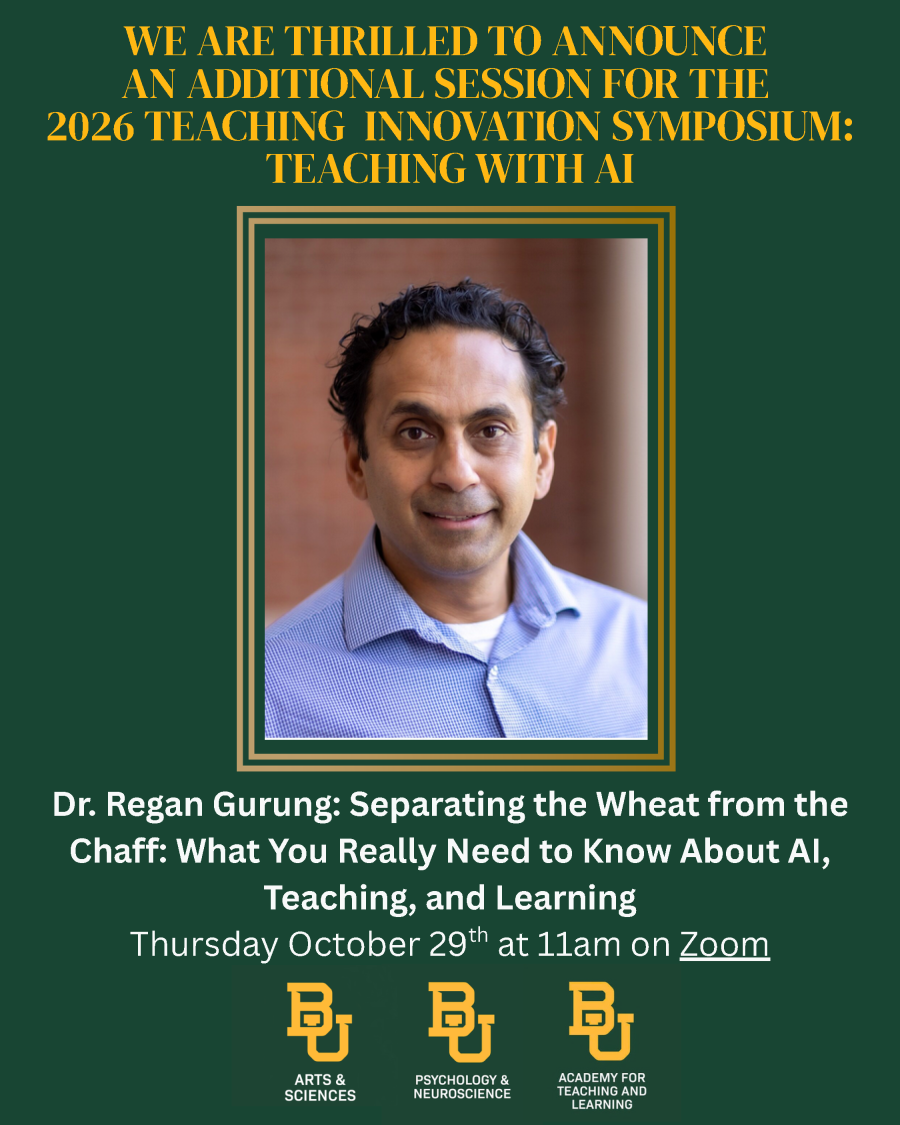
Great news! Dr. Regan Gurung has agreed to deliver an encore presentation* of his talk, Separating the Wheat from the Chaff: What You Really Need to Know About AI, Teaching, and Learning – this time virtually!
Thursday, October 29, 2026
11:00am-12:00pm
Online only: Zoom link will be sent to registrants.
*Please note: If you joined us in person for the original session on October 2, this offering will primarily repeat that presentation. We are offering this virtual encore so that more Baylor faculty can hear Dr. Gurung speak and so that we can record the session and add it to our Box resource folder for future access.
Session overview: AI presents us all with many different affordances. Universities are scrambling to establish AI policies to guide faculty, staff, and student use of this blossoming technology, but some big questions still need to be addressed. In this presentation, author, psychologist, and pedagogical expert Dr. Regan Gurung (Oregon State University) will provide a snapshot of current faculty and student attitudes toward AI to establish a framework for thinking about how we work with AI. He will consider what is lost when we use AI and what is gained through an evenhanded sifting and winnowing of current empirical research on AI in higher education. In particular, Dr. Gurung will focus on the questions we should all ask ourselves as we decide how much to invite Large Language Model agents into our lives.
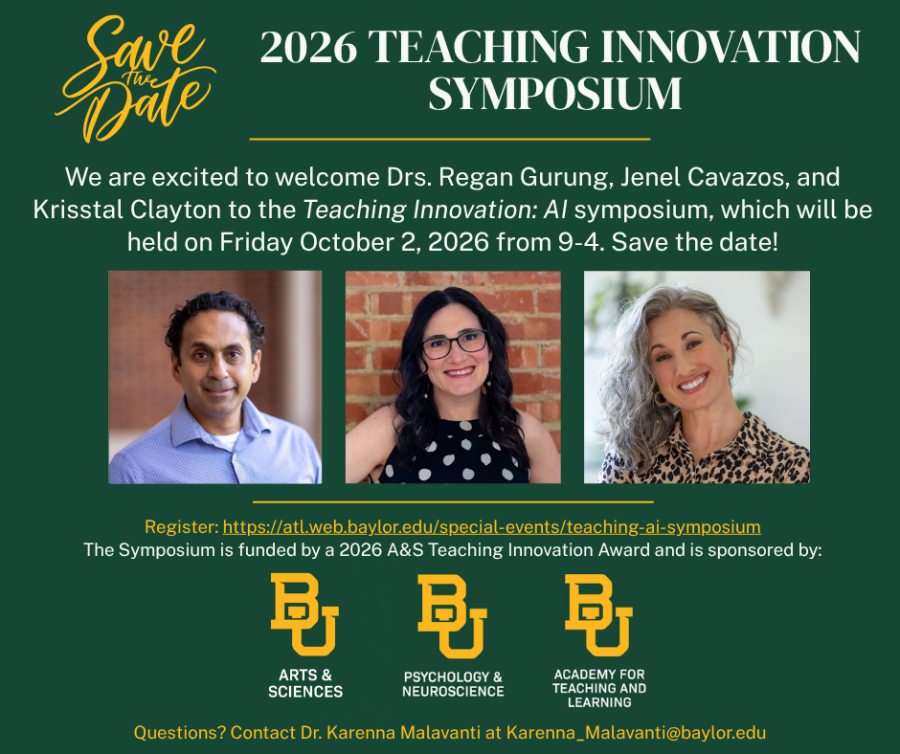
Join us Friday, October 2, for a one-day conference featuring experts in teaching and learning offering perspectives, provocations, and practical guidance for teaching with AI. This symposium is supported by a College of Arts & Sciences Teaching Innovation Award.
Welcome and Opening Remarks
Charles Weaver, Ph.D. | College of Arts & Sciences
9:00 am - 9:05 am | Schumacher Flex Commons
Separating the Wheat from the Chaff: What You Really Need to Know About AI, Teaching, and Learning
Speaker: Regan Gurung (OSU), Ph.D.
9:05 am- 10:20 am | Schumacher Flex Commons
AI presents us all with many different affordances. Universities scramble to establish AI policies to guide faculty, staff, and student use of this blossoming technology but there are some big questions that still need to be addressed. In this presentation, I shall first provide a snapshot of current faculty and student attitudes towards AI to establish a framework to guide how we work with AI. We will consider what is lost when we use AI and what is gained with an evenhanded sifting and winnowing of current empirical research on AI in higher education. In particular, we focus on the questions we should all ask ourselves as we decide how much to invite Large Language Model agents into our lives.
Interviews, Debates, and Devil's Advocates: AI Assignment Designs That Deepen Student Learning
Speaker: Jenel Cavazos (OU), Ph.D.
10:30 am - 11:45 am | Moody 104
Generative AI has put faculty in a difficult position: ignore it, ban it, or design around it. This hands-on session offers a fourth option — create assignments that use AI as a thinking partner while keeping the cognitive work squarely with students. Drawing on examples from a large-enrollment introductory psychology course, we'll work through several scalable, adaptable assignment templates, each tied to a distinct learning goal: perspective-taking, theoretical application, and metacognitive critique. Participants will leave with a draft of at least one AI-augmented assignment adapted to their own course, plus practical guidance on framing, disclosure, and assessment.
What Does it Take to Teach Like a Champ? A Discussion with Regan Gurung
Speaker: Regan Gurung (OSU), Ph.D.
Moderator: Karenna Malavanti, Ph.D.
12:00 pm - 1:15 pm | Moody 104 | Register for SET here (separate from symposium registration)
Putting the “Intelligence" into Students' Usage of AI: Teaching the Importance of Expertise
Speaker: Krisstal Clayton (UNT), Ph.D.
1:30 pm - 2:45 pm | Schumacher Flex Commons
Artificial intelligence (AI) tools have become increasingly integrated into academic and professional environments. While students will likely need AI skills for the workplace, and many use it for learning and assignment completion, AI-generated output is not always accurate. Identifying these inaccuracies requires human intelligence. Thus, students would benefit from applying their expertise and skepticism when interacting with AI. As educators, we have a unique opportunity to help students develop their critical thinking skills about AI in the practical context of a controlled classroom setting while meeting essential learning objectives. Using Milgram’s Obedience Study and simulated ChatGPT output, a 4-part assignment was created to teach students about Milgram’s classic study, basic experimental design, ethics in research, APA formatting, and flawed survey items. To investigate performance, students were primed to perceive ChatGPT-generated responses as either imperfect or trustworthy. Student attitudes towards AI were also collected. The importance of human intelligence as the foundation for using AI as a tool will be highlighted.
Teaching and AI: Q&A
Speakers: Regan Gurung, Ph.D., Jenel Cavazos, Ph.D., and Krisstal Clayton, Ph.D.
Moderator: Karenna Malavanti, Ph.D.
3:00 pm - 3:45 pm | Moody 104
In this Q&A with our keynote speakers Regan Gurung, Jenel Cavazos, and Krisstal Clayton, we will explore common questions about AI use, academic integrity, student engagement, ethical considerations, and equitable access. The conversation will highlight strategies for integrating AI as a tool to support critical thinking and inclusive pedagogy, while also acknowledging its limitations and risks.
Closing Remarks
Lee Nordt, Ph.D. | Office of the Provost
3:45 pm - 4:00 pm | Moody 104