

• Skip to main content
  • Skip to main navigation
Baylor University Baylor University
Academy for Teaching and Learning
  • About
    • About the ATL
    • Advisory Council
    • Event Calendar
    • Gleanings News Items
    • Graduate Fellows
      • Apply
      • Former Fellows
    • Staff Directory
  • Programs
    • 10:10:10 AI Microlearning
    • 30-Minute Mastery
    • Active Learning Lab Fellowship
      • Former Fellows
    • Baylor Fellows
      • About the Baylor Fellows
    • Cherry Award Summit on Great Teaching
    • Classroom Observations
    • Course Makeover Workshop
    • Education Research Journal Club
    • Faculty Institutes
    • Faculty Interest Groups
    • Foundations for Teaching Lab Workshop
    • Foundations for Teaching Workshop
    • Jump Start Teaching Workshop
    • Online Faculty Institute
      • OFI Campus Visit Resources
    • Provost's Faculty Forum
    • Seminars for Excellence in Teaching
      • SET Archive
    • Teaching Capstone in Higher Education
      • Completing the Teaching Capstone in Higher Education
      • Five Categories of TeaCHE
      • TeaCHE FAQ
    • Thank an Instructor
    • University Teaching Development Grants
      • UTDG Testimonials
    • University Teaching Exploration Grants
      • Past UTEG Projects
  • Special Events
    • Teaching and Learning Research Exchange
    • Current Special Events
  • Professors Talk Pedagogy
    • Season 1
    • Season 2
    • Season 3
    • Season 4
    • Season 5
    • Season 6
  • Resources
    • AI Resources
    • ATL Publications
    • Book Reviews
    • Document Depot
    • Learning Technologies
    • Lending Library
    • Self and Syllabus: An Interactive Guide for Aligning Syllabus Language and Teacher Self-Perception
    • Theological Convictions and Pedagogical Practices
      • Incidents (Or Narrative Slices) of Teaching at Its Best
      • Process for Reflecting on Incidents of Teaching at Its Best
      • Categories for Questions to Explore Incidents of Teaching at Its Best
      • Considerations for Using the Reflective Process Beginning with Incidents of “Teaching at its Best”
      • Learning Abstract and Grant Project Summary
    • Video Library
  • Teaching Guides
    • Preparing to Teach
      • Learning Goals and Objectives
      • Learning Activities
      • Learning Assessment
      • Creating a Syllabus
      • First Day of Class
      • Flipped Learning
      • Universal Design for Learning
      • Open Educational Resources
      • Making the Most of Office Hours
    • Considering Students
      • How Students Learn
      • Underperforming and At-Risk Students
      • Supporting International Students
      • Classroom Incivilities
      • Prior Knowledge
      • Inclusive Teaching
      • Classroom Community
      • Emotions in Learning
      • Compassionate Teaching
      • Student Motivation in the Classroom
    • Teaching Techniques
      • Effective Lectures
      • Interactive Methods
      • Effective PowerPoint
      • Discussions that Teach
      • Service Learning
      • Controversial or Sensitive Topics
      • Team-Based Learning
      • In-Class Writing Prompts
    • Assessing Student Learning and Teaching
      • Formative Assessment
      • Summative Assessment
      • Grading Rubrics
      • Effective Feedback
      • Instructor Self-Assessment
      • Ungrading
      • Alternative Assessments
    • Teaching with Technology
      • Considering Technology for Teaching
      • Teaching without Technology
      • Classroom Response Systems
      • Blended Learning
      • Instructor-Created Videos
      • Engagement in Online Learning
      • Socialization in Online Learning
    • Researching Teaching and Learning
      • Surveys-An Introduction
      • Survey Delivery and Participation
      • Preparing to Write Survey Questions
      • Attitudinal Questions and Likert Scales
      • Question Wording and Practical Tips
      • Baylor IRB Quick-Start Guide
  • Give
  • Subscribe
Baylor BU Academy for Teaching and Learning Teaching Guides Preparing to Teach Flipped Learning
  • Preparing to Teach
    • Learning Goals and Objectives
    • Learning Activities
    • Learning Assessment
    • Creating a Syllabus
    • First Day of Class
    • Flipped Learning
    • Universal Design for Learning
    • Open Educational Resources
    • Making the Most of Office Hours
  • Considering Students
  • Teaching Techniques
  • Assessing Student Learning and Teaching
  • Teaching with Technology
  • Researching Teaching and Learning

Flipped Learning

A “flipped” classroom inverts the setting of traditional learning activities for the sake of efficiency and deeper learning (Flipped Learning Network, 2014). As pioneers Bergmann and Sams (2012) put it, instructors begin by asking, “Which activities that do not require my physical presence can be shifted out of the class in order to give more time to activities that are enhanced by my presence?” (p. 96). For many instructors, the answer to this question is “lectures” or “direct instruction,” which can be offered to students asynchronously through videos, slides, texts, or audio presentation. In-person class time is then used for collaborative, hands-on learning and various methods of interactive learning (Karabulut-Ilgu et al., 2018). This model resonates with constructivist learning theory, in which acquisition of fundamental knowledge is followed by application and evaluation of knowledge (Heiss et al., 1950; Bybee, 1993; Lawson, 2002; Jensen et al., 2015).

Consider a common experience in a traditional class: the student is required to read a chapter from a textbook before class, come to class to listen to a lecture that presents similar or elaborative information, and work on applying this knowledge after class in the form of problem sets or writing exercises. This model could be inefficient because the information is repeated (in pre-class reading and in-class lecture)—perhaps an unnecessary redundancy and often a disincentive for students to complete pre-class reading. This model could also be ineffective for deeper learning, since the student working alone on problems or a writing assignment does not have the benefit of immediate interaction with the instructor.

In a flipped classroom, however, the student only receives redundant information if she chooses (by re-reading or re-watching pre-class assignments). Additionally, since the student will be working on higher-order tasks (like problem sets or writing assignments) in class, she will have immediate access to the instructor, who can correct mistakes, provoke thought with questions, or provide additional information precisely as it is needed.

Flipping a classroom affects the roles of instructors and students. Instructors do not primarily dispense information but curate information for pre-class work and flexibly interact with students in class. Students are more responsible for preparatory work and must actively engage with material, classmates, and the instructor in class.

Benefits and Challenges of Flipped Learning

Flipped learning leverages the expertise of the instructor in its most impactful setting. When the instructor is delivering large chunks of information without the need for interaction, there is no compelling reason for students and instructor to be present in the same room at the same time. By moving this direct instruction outside the classroom, instructors can use their expertise to help students in a targeted way in class: giving more attention to struggling students and providing additional challenges for advanced students. In other words, flipped learning can facilitate “differentiated learning.” Relatedly, compared to traditional classes, flipped learning increases both the number of students who participate in class and the amount of each students’ participation. Class participation is not dominated by a few bright or outgoing students (Bergman & Sams, 2012). Students interact with each other more, which in well-designed learning spaces increases higher-order learning (King, 2002). Flipped learning also increases students’ intrinsic motivation to complete pre-class work as it supports their quest for mastery and social interdependency when working in class (Bruner, 1966). Students appreciate having control over the pace of their learning; for instance, being able to pause, rewind, and re-watch videos and receive clarification and reinforcement during class. This also improves their learning by reducing cognitive load (Seery, 2015).

Flipped learning brings challenges. When accessing material outside of class, students cannot immediately ask questions as they might be able to with a live in-person lecture. Instructors must also consider accessibility of materials (see Universal Design for Learning). Because students may be unfamiliar with self-paced learning, instructors should teach students to engage well; for instance, coaching students in taking notes, writing questions, and manipulating videos with pause and rewind. As with any strategy that incorporates interactive methods, students may balk at the increased engagement expected of them and greater responsibility assigned them for their learning (Seery, 2015). Similarly, interactive methods often require classrooms with flexible furniture or additional supplies or technologies, which may put burdens on the instructor or institution. Curating or creating content for students can also be time-consuming. Many advocates of flipped learning therefore advise instructors to gradually flip their classes unit-by-unit over several terms or years.

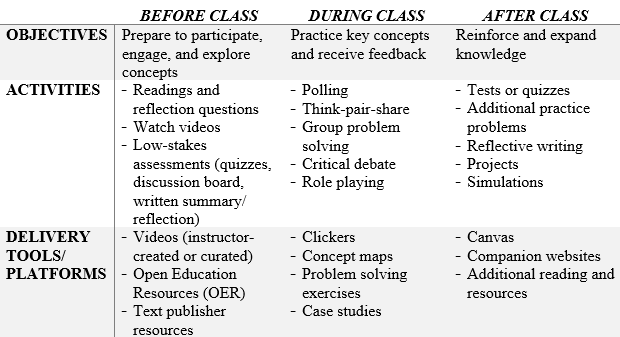
Learning Cycle in a Flipped Classroom

Baylor instructors Solis and Hunter (2017) break down the flipped classroom into three sections. Before class involves activities that help students prepare for in-class participation. Activities during class give students opportunities to analyze data and apply key concepts with the instructor to provide real-time expert feedback. Lastly, exercises and supplemental resources after class allow students to check their understanding and extend their learning.
Designing and Implementing the Flipped Classroom

Below are recommendations for designing and implementing a flipped learning course, modified from Rotellar and Cain (2016).

Design

1.    Provide an incentive for students to prepare for class

2.    Make clear connections between in-class and out-of-class activities

3.    Provide ample time for students to complete assignments

4.    Assess student understanding in both off-loaded and in-class modes

5.    Structure activities that foster community

6.    Overlap pre-class and in-class content so it is necessary for students to complete both to be successful

7.    Provide opportunities for students to clarify information contained in off-loaded materials

8.    Focus in-class activities on higher-order thinking and skills

Delivery

1.    Use familiar and accessible technologies

2.    Be explicit with students about their responsibility and coach students in productive learning practices

3.    Enlist additional personnel (e.g., teaching assistants) for the demands of in-class activities

4.    Provide prompt formative feedback on in-class individual or group work


References

Bergmann, J., & Sams, A. (2012). Flip your classroom: reach every student in every class every day. International Society for Technology in Education.

Bruner, J. (1966). Toward a theory of instruction. Belknap Press.

Bybee R (1993). An instructional model for science education: Developing biological literacy. Biological Sciences Curriculum Studies.

Flipped Learning Network (2014). The Four Pillars of F-L-I-PTM. Accessed through
https://flippedlearning.org/wp-content/uploads/2016/07/FLIP_handout_FNL_Web.pdf.

Heiss E.D., Obourn E.S., & Hoffman C.W. (1950). Modern Science Teaching. Macmillan.

Johnson, L., Adams Becker, S., Cummins, M., Estrada, V., Freeman, A., & Hall, C. (2016). NMC horizon report: 2016 Higher education edition. New Media
Consortium. Accessed through https://www.learntechlib.org/p/171478/.

King, A. (2002). Structuring Peer Interaction to Promote High-Level Cognitive Processing. Theory Into Practice, 41(1), 33-39.

Karabulut-Ilgu A., Cherrez N.J., & Jahren C.T. (2018). A Systematic Review of Research on the Flipped Learning Method in Engineering Education. British Journal of Educational Technology, 49(3), 398-411. DOI: 10.1111/bjet.12548

Lawson A.E. (2002). Science teaching and development of thinking. Wadsworth/Thompson Learning.

Rotellar, C., & Cain, J. (2016). Research, Perspectives, and Recommendations on Implementing the Flipped Classroom. American Journal of Pharmaceutical Education, 80(2), 34. https://doi.org/10.5688/ajpe80234

Seery, M.K. (2015). Flipped Learning in Higher Education Chemistry: Emerging Trends and Potential Directions. Chemistry Education Research and Practice, 16, 758-768. DOI: 10.1039/c5rp00136f

Solis, J.D., and Hunter, E. (2017). Demystifying the Flipped Classroom. Baylor University, faculty presentation.

Creative Commons License
This work is licensed under a Creative Commons Attribution-NonCommercial 4.0 International License.

Academy for Teaching and Learning

Moody Library, Suite 201

One Bear Place
Box 97189
Waco, TX 76798-7189

atl@baylor.edu
(254) 710-4064
Staff Directory
Seminars for Excellence in Teaching
Teaching Capstone in Higher Education
Teaching Exploration Grants
University Teaching Development Grants
Professors Talk Pedagogy
Baylor BU Academy for Teaching and Learning Teaching Guides Preparing to Teach Flipped Learning
  • About
    Back
    • About the ATL
    • Advisory Council
    • Event Calendar
    • Gleanings News Items
    • Graduate Fellows
      Back
      • Apply
      • Former Fellows
        Back
        • Earlier Graduate Fellows
    • Staff Directory
  • Programs
    Back
    • 10:10:10 AI Microlearning
    • 30-Minute Mastery
    • Active Learning Lab Fellowship
      Back
      • Former Fellows
    • Baylor Fellows
      Back
      • About the Baylor Fellows
    • Cherry Award Summit on Great Teaching
    • Classroom Observations
    • Course Makeover Workshop
    • Education Research Journal Club
    • Faculty Institutes
    • Faculty Interest Groups
    • Foundations for Teaching Lab Workshop
    • Foundations for Teaching Workshop
    • Jump Start Teaching Workshop
    • Online Faculty Institute
      Back
      • OFI Campus Visit Resources
    • Provost's Faculty Forum
    • Seminars for Excellence in Teaching
      Back
      • SET Archive
    • Teaching Capstone in Higher Education
      Back
      • Completing the Teaching Capstone in Higher Education
      • Five Categories of TeaCHE
        Back
        • TeaCHE Category 1
          Back
          • Guidelines for Approval of Departmental Preparation Courses
        • TeaCHE Category 2
        • TeaCHE Category 3
        • TeaCHE Category 4
        • TeaCHE Category 5
          Back
          • Preapproved TeaCHE Category 5 Events
      • TeaCHE FAQ
    • Thank an Instructor
    • University Teaching Development Grants
      Back
      • UTDG Testimonials
    • University Teaching Exploration Grants
      Back
      • Past UTEG Projects
  • Special Events
    Back
    • Teaching and Learning Research Exchange
    • Current Special Events
  • Professors Talk Pedagogy
    Back
    • Season 1
    • Season 2
    • Season 3
    • Season 4
    • Season 5
    • Season 6
  • Resources
    Back
    • AI Resources
    • ATL Publications
    • Book Reviews
    • Document Depot
    • Learning Technologies
    • Lending Library
    • Self and Syllabus: An Interactive Guide for Aligning Syllabus Language and Teacher Self-Perception
    • Theological Convictions and Pedagogical Practices
      Back
      • Incidents (Or Narrative Slices) of Teaching at Its Best
      • Process for Reflecting on Incidents of Teaching at Its Best
      • Categories for Questions to Explore Incidents of Teaching at Its Best
      • Considerations for Using the Reflective Process Beginning with Incidents of “Teaching at its Best”
      • Learning Abstract and Grant Project Summary
    • Video Library
  • Teaching Guides
    Back
    • Preparing to Teach
      Back
      • Learning Goals and Objectives
      • Learning Activities
      • Learning Assessment
      • Creating a Syllabus
      • First Day of Class
      • Flipped Learning
      • Universal Design for Learning
      • Open Educational Resources
      • Making the Most of Office Hours
    • Considering Students
      Back
      • How Students Learn
      • Underperforming and At-Risk Students
      • Supporting International Students
      • Classroom Incivilities
      • Prior Knowledge
      • Inclusive Teaching
      • Classroom Community
      • Emotions in Learning
      • Compassionate Teaching
      • Student Motivation in the Classroom
    • Teaching Techniques
      Back
      • Effective Lectures
      • Interactive Methods
      • Effective PowerPoint
      • Discussions that Teach
      • Service Learning
      • Controversial or Sensitive Topics
      • Team-Based Learning
      • In-Class Writing Prompts
    • Assessing Student Learning and Teaching
      Back
      • Formative Assessment
      • Summative Assessment
      • Grading Rubrics
      • Effective Feedback
      • Instructor Self-Assessment
      • Ungrading
      • Alternative Assessments
    • Teaching with Technology
      Back
      • Considering Technology for Teaching
      • Teaching without Technology
      • Classroom Response Systems
      • Blended Learning
      • Instructor-Created Videos
      • Engagement in Online Learning
      • Socialization in Online Learning
    • Researching Teaching and Learning
      Back
      • Surveys-An Introduction
      • Survey Delivery and Participation
      • Preparing to Write Survey Questions
      • Attitudinal Questions and Likert Scales
      • Question Wording and Practical Tips
      • Baylor IRB Quick-Start Guide
  • Give
  • Subscribe
  • General Information
  • Academics & Research
  • Administration
  • Admissions
  • Gateways for ...
  • About Baylor
  • Athletics
  • Ask Baylor
  • Bookstore
  • Calendar
  • Campus Map
  • Directory
  • Give to Baylor
  • News
  • Search
  • Social Media
  • Strategic Plan
  • College of Arts & Sciences
  • Diana R. Garland School of Social Work
  • George W. Truett Theological Seminary
  • Graduate School
  • Hankamer School of Business
  • Honors College
  • Law School
  • Louise Herrington School of Nursing
  • Moody School of Education
  • Research at Baylor University
  • Robbins College of Health and Human Sciences
  • School of Engineering & Computer Science
  • School of Music
  • University Libraries, Museums, and the Press
  • More Academics
  • Athletics
  • Compliance, Risk and Safety
  • Human Resources
  • Marketing and Communications
  • Office of General Counsel
  • Office of the President
  • Office of the Provost
  • Operations, Finance & Administration
  • Senior Administration
  • Student Life
  • University Advancement
  • Undergraduate Admissions
  • goBAYLOR
  • Graduate Admissions
  • Baylor Law School Admissions
  • Social Work Graduate Programs
  • George W. Truett Theological Seminary Admissions
  • Online Graduate Professional Education
  • Virtual Tour
  • Visit Campus
  • Alumni & Friends
  • Faculty & Staff
  • Online Graduate Professional Education
  • Parents
  • Prospective Faculty & Staff
  • Prospective Students
  • Students
  • Anonymous Reporting
  • Annual Fire Safety and Security Notice
  • Cost of Attendance
  • Digital Privacy
  • Legal Disclosures
  • Mental Health Resources
  • Notice of Non-Discrimination
  • Report It
  • Title IX
  • Web Accessibility
 
Baylor University
Copyright © Baylor® University. All rights reserved.
Baylor University • Waco, Texas 76798 • 1-800-229-5678